About

A computing educator and creative technologist working at the intersection of computation, design, and human learning.
My research and teaching explore how generative AI is reshaping learning, metacognition, creativity, and expertise, and how higher education can prepare students to work with intelligent systems critically, ethically, and creatively.
This work builds on more than twenty years of creating autonomous and generative computational systems that produce art, audio, and text. Across my work, I investigate how human needs, values, and creative practices shape the technologies we build, and how technology changes how we think, learn, and create.
Teaching
Philosophy
My classroom approach draws on cognitivism and constructivism: I believe students build understanding through hands-on experimentation, reflection, and revision rather than passive listening. Most real problems don't have one right answer or approach, so I want students to grow comfortable with ambiguity and iteration rather than searching for a single correct method. Mastering course content is only part of the goal. I want students to leave each course with the confidence to think and create independently, ready to meet new problems with curiosity, adaptability, and a willingness to iterate until their goals are achieved.
Pedagogy
In practice, this means borrowing structures from Agile development and iterative design. Every class includes protected time to test ideas without the pressure of grades, which opens the door to intellectual risk-taking and meets students wherever their prior experience puts them. I build in recurring cycles of experimentation, evaluation, and refinement, so revision becomes a normal and expected part of the process rather than a sign of failure.
Scholarship
Publications and Papers
Six Steps to Optimize Your Social and Digital Presence: A How-To Guide for Academics. Inside HigherEd. Baxter, Janell R., and Anne M. Mitchell, 2018. Online.
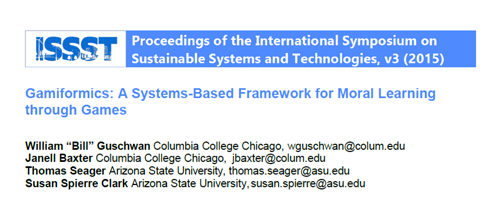
Gamiformics: A Systems-Based Framework for Moral Learning Through Games. In Proceedings of the International Symposium Sustainable Systems and Technologies, v3 (2015), Vol. 3. International Symposium Sustainable Systems and Technologies, Guschwan, William D., Janell R. Baxter, Thomas Seager, and Susan Spierre. 2015.
STEM Education: Creating Meaningful Experiences with Interaction Design (Extended Session Abstract). Lecture Notes of the Institute for Computer Sciences, Social Informatics and Telecommunications Engineering, Vol. 136, 2014.
Generative Art and Pragmatic Physical Computing. Media-N, Journal of the New Media Caucus, V.06 N.01, 2010.
Games for Change: Creating Games of Social Value, Claiming Creativity: Art Education in Cultural Transition. A Joint International Symposium presented by Columbia College Chicago in partnership with the European League of Institutes of the Arts (Chicago, Illinois). With Mindy Faber. 2010. PDF.
Introduction to HTML Authoring. Aesthetics of Interactive Multimedia Course-Pack, 2002.
Virtual Learning Community: Online Tools Support In-class Teaching. Iverson, B.K. & Baxter, J. SITE, 2001. Abstract.
Writing
Recent Articles
Code-Adventure
- Evolution of Programmability: Encode, Automate, Transform
The punch card eventually disappeared. The idea behind it didn't; information could be encoded in a form a machine could act upon.
.. - Build Strong Coding Habits
Professional developers don't just write good code, they also develop habits that save time, reduce frustration, and improve debugging.
.. - Decimal and Binary: Numeral System Conversions
Learning how to convert between numeral systems such as decimal and binary deepens an understanding of how computers interpret information.
.. - Bits and Binary: The Language of Computers
Computers use binary because electronic circuits can reliably detect two electrical states, such as low voltage and high voltage.
.. - Hexadecimal Numeral System (Base-16)
The hexadecimal (base-16) numeral system uses both digits and letters; the digits 0–9 represent values 0 to 9, and then letters A–F represent values from 10 to 15.
.. - Decimal Numeral System (Base-10)
The decimal (base-10) numeral system uses the digits 0–9 to represent values. It is the most widely used numbering system in everyday life and is the standard system for..
Technical Editor
Technical Editor, Return on Engagement: Content Strategy and Web Design Techniques for Digital Marketing by Tim Frick and Kate Eyler-Werve. 2nd Edition, ISBN: 978-0-415-84461-1. 2014
Contributing Editor
Contributing Editor, BootCamp Manual. McCarthy Technologies. 2003, 2006
Contributing Editor, Dictionary of Artists, Managers, Performers, and Entrepreneurs by Chuck Suber. 3rd Edition, ISBN: 0929911059. 2002.
Code-Adventure
Articles and Lecture Notes. Teaching materials used in the PROG 102 Code course.
Coding videos. Podcasts and musical mnemonics.
Programming is Fun
C# Adventure Game. A guided hands-on introduction to programming in C#.
Programming is Fun: Playful Code Adventures A collection of code examples and information.
Select Projects
Bot Squad
Five bots collaborating together. One develops a creative prompt that another builds work based on. The creative prompts are also published to a website and to Twitter. Completed works are shown to a GAN and the results are compared to the orginal creative prompt.
- Creative Prompt Creation Bot: A bot that suggests topics for creative work. A daily prompt is saved in a database and the last 20 prompts are published to a companion website. The website also generates new prompts and links to search results for words that make up the prompt phrase.
- Creative Prompt Promotion Bot: published daily prompts on Social Media.
- Ent Creation Bot: Creates work based on the daily prompts.
- Critic Bot: This bot passes work made by Ent Creation to a GAN that evaluates it and responds with the subject matter.
- Evaluation Bot: This bot compares the intended subject matter of a creation to the external GAN's interpretation.
2004 to Present
This project is an evolution of a series of bots that make artwork that has been shown in galleries and art shows.
This squad of bots was shown and discussed at the IAM Faculty and Staff Showcase (4/12/22) at Columbia College Chicago.
Introduction to Programming
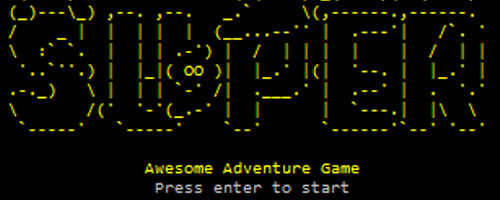
Code Adventure: C#
C# Adventure walks through the creation of a text-based adventure game in C#, and along the way teaches programming fundamentals. It's designed for those with little or no programming experience.
Many students want to learn in a way that is:
- In context
- Relatable to their interests
- Hands-on
In Context
Topics are introduced in the context of building a project when they are needed ("just in time"). An adventure game has text, and that is a great opportunity to introduce string data types. When tracking Player points, integers are discussed.
Relatable
For many, creating a game is more motivating than a calculator or budget application. Games can incorporate calculations and the budgeting of resources, but the investment for students is generally higher if it is framed in something they want to build.
Hands-on Creation
Learning is often more meaningful if students are creating something tangible. Instead of a long lecture or a chapter of text, students are encouraged to switch modes and build. Developing an example of the concept being discussed reinforces understanding, and provides an example to return to later.
Try It
Build a text adventure game and learn programming basics along the way: C# Adventure.
Select Media
Podcasts
Build Strong Coding Habits: Develop strong coding habits that save time, reduce frustration, and improve debugging.
Computational Thinking: Computational thinking helps us break big, messy problems into smaller pieces, spot patterns, focus on what really matters, and create a step-by-step plan to move forward. In this podcast, we’ll explore key computational thinking concepts: decomposition, pattern recognition, abstraction, algorithms, and evaluation.
Comics
Build Strong Coding Habits: Professional developers don’t just write good code. They also develop strong habits that save time, reduce frustration, and improve debugging.
Computational Thinking: Even if you’ve never written a line of code, you can think like a programmer. Breaking big problems into small ones, spot patterns, and evaluate what is working, and what should change.